
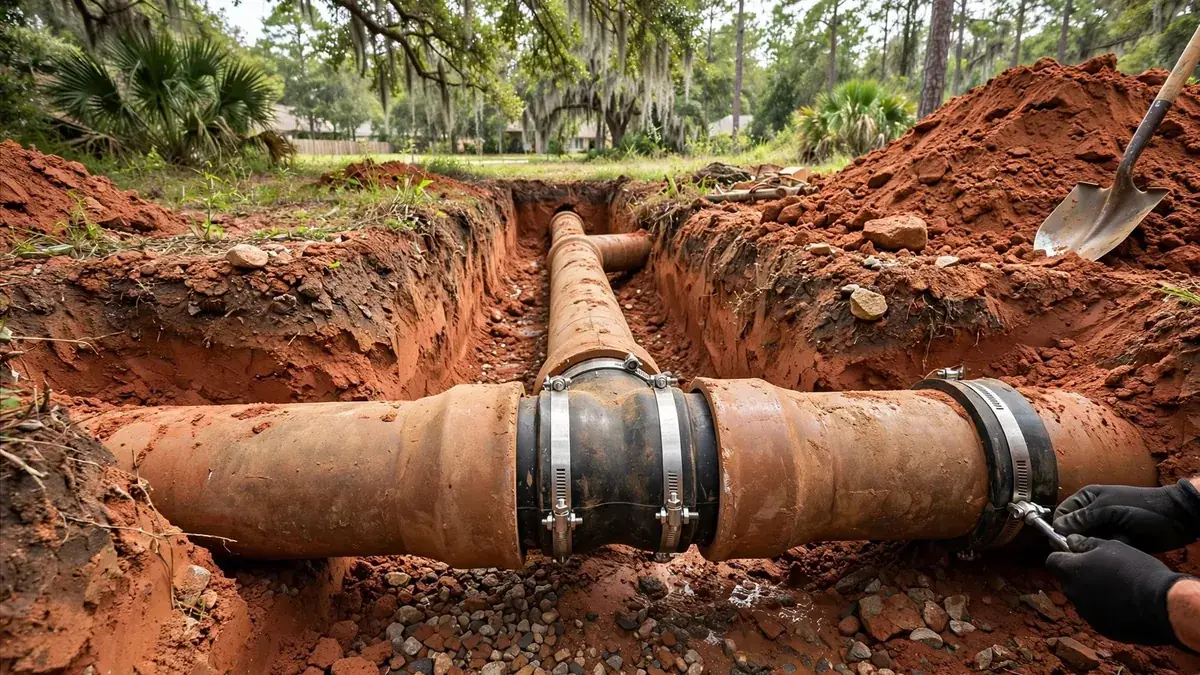
Sewer line repair starts with finding the break
Sewer line repair means fixing or replacing the pipe that carries wastewater from your house to the district main. If sewage is coming up inside right now, the 24/7 line sends a licensed plumber, and the first goal in an emergency is to get the line draining again so the house is usable. The repair decision comes after, once a camera shows what failed.
Cleaning and repair are different jobs. A cable clears a blockage. It does nothing for a pipe that has cracked, sagged or pulled apart at a joint. Repeated backups, a gurgle in the toilet after the washer runs and a wet patch in the yard are the signs that sit on the repair side.
When a sewer problem is an emergency, and when the pipe itself has failed
One of these alone may be a clog. Several together point to a broken line, and sewage inside the house is an emergency whatever the cause.
- Backups that return within weeks of a successful cable clearing
- A sewage smell in the yard or near the foundation
- A soggy or sunken patch of lawn that stays wet in dry weather
- Slow drains in every fixture at once instead of a single sink
- Gurgling from toilets or tubs when another fixture drains
- A cable that stops at the same spot each time, or comes back with soil on it
A change in the yard is worth taking seriously. Sewer pipe that has cracked lets wastewater leak out and soil leak in, and the ground above can settle over months.
What to do if sewage is backing up
Sewage carries bacteria, so the first goal is to limit contact and stop adding water to the line.
- Stop using every sink, tub, shower, toilet, dishwasher and washing machine.
- Keep children and pets out of any room with wet floors or drains that are bubbling.
- Do not pour drain cleaner or mix chemicals into backed-up drains, since a plumber may need to work in them.
- Photograph the damage before anything is moved, for your insurer.
- Tell the dispatcher whether you are on city sewer or a septic tank.
How the camera finds the defect, and what it shows
A waterproof camera on a flexible rod goes in through the cleanout and travels down the line. It shows cracks, a joint that has pulled apart, a belly where the pipe sags and holds water, roots entering at a seam and scale on old iron. A locator then tracks the camera head from above ground so the plumber knows how deep the problem is and where to dig if digging is needed.
This is the step that prevents the wrong repair. Replacing a whole line over one cracked joint wastes money, and patching one joint on a line that is failing everywhere does not last. The page on camera inspection of sewer lines explains what footage can and cannot show.
Repair options and what each one fits
The right option depends on how much of the pipe is damaged and what lies above it.
| Option | Fits | Limit |
|---|---|---|
| Spot repair (dig and replace a section) | One short, well-located defect | Rest of the line stays as it was |
| Sleeve or short liner patch | A localized crack or open joint | Cannot correct a sag or collapse |
| Full-length liner (epoxy or cured-in-place) | Long runs with cracks and roots but a pipe that is still round | Needs a clear, intact path for the liner |
| Trenchless pipe replacement | Failed line where yard, drive or trees should stay | Needs entry and exit points and a workable pipe route |
| Open-cut replacement | Collapsed, offset or severely sagging pipe | Digs up the yard or the floor above the line |
Epoxy lining and pipe lining also come up for lines under a slab. They can be an option there when the pipe is intact enough to take the liner, and the camera is how that gets answered.
Pipe lining and trenchless options, with honest trade-offs
Lining builds a new pipe inside the old one. A resin-soaked tube is pulled or inverted through the line and cured in place, leaving a smooth interior with fewer joints for roots to enter. It saves the yard, and it works when the existing pipe is round and continuous.
It does not work everywhere. A collapsed section, a large offset or a deep belly usually has to be dug out, because the liner follows the pipe's shape and cannot straighten it. Trenchless replacement, in which a new pipe is pulled through as the old one is broken up, handles more cases but needs access at both ends. Lining also narrows the pipe slightly. Neither method fits every address, and an honest plumber says when digging is the better call.
Cast iron and clay pipe in older Radcliff homes
Radcliff expanded around Fort Knox through much of the last century, so many houses have older drain lines. Cast iron rusts from the inside and can flake or crack. Clay pipe comes in short sections with many joints, and each joint is a place where roots and soil can get in.
Camera footage separates a pipe that is rough but sound from one that is thin or breaking. If it is sound, cleaning or lining may extend its life. If it is not, a partial fix does not last, because the weak section next to the repair fails next. Where a long run is deteriorating, replacing the drain piping may be the more durable plan.
Who is responsible for which section
HCWD1 operates the Radcliff sewer system, and the private line from your house meets the district main at a point that varies by property. Ask HCWD1 where its line ends for your address. The camera then shows which side of that point the defect is on, and that tells you whether the repair is yours or the district's to look at.
Terrain, rain and winter in the repair picture
Radcliff drains into 86 known sinkholes, and the ground here is karst. Heavy rain can saturate soil and move it around buried pipe, and a pipe that is already cracked takes in extra water and soil. After a big storm, a line that was borderline can start backing up.
The ice storms recorded in the Hardin County area in November 2018 and February 2021 are a reminder that winter freeze and thaw works on the ground too. A sewer line is buried below the frost line in most cases, but shallow sections near a foundation or a patio can still be disturbed. If you are comparing repair options, tell the dispatcher about any new yard settling.
What moves the price of a sewer line repair
The price is stated before work begins. These are the main factors.
A single defect is a small job. A line failing along its full run is a larger project, sometimes better handled by replacement than patches.
A shallow line in an open yard is straightforward. A deep line under a driveway, a slab or a tree costs more to reach.
Spot digging, lining, trenchless replacement and open-cut each carry different equipment and labor needs.
Landscaping, concrete or flooring repair after the work is a separate scope from the plumbing.
Same-day appointments suit a planned repair. A line that is backing up at night is handled as an emergency first, with the full repair scheduled afterward.
Insurance often covers sudden damage but not wear or aging pipe, and some policies exclude sewer lines unless an endorsement was added. Ask your insurer, and photograph any water damage before cleanup.