
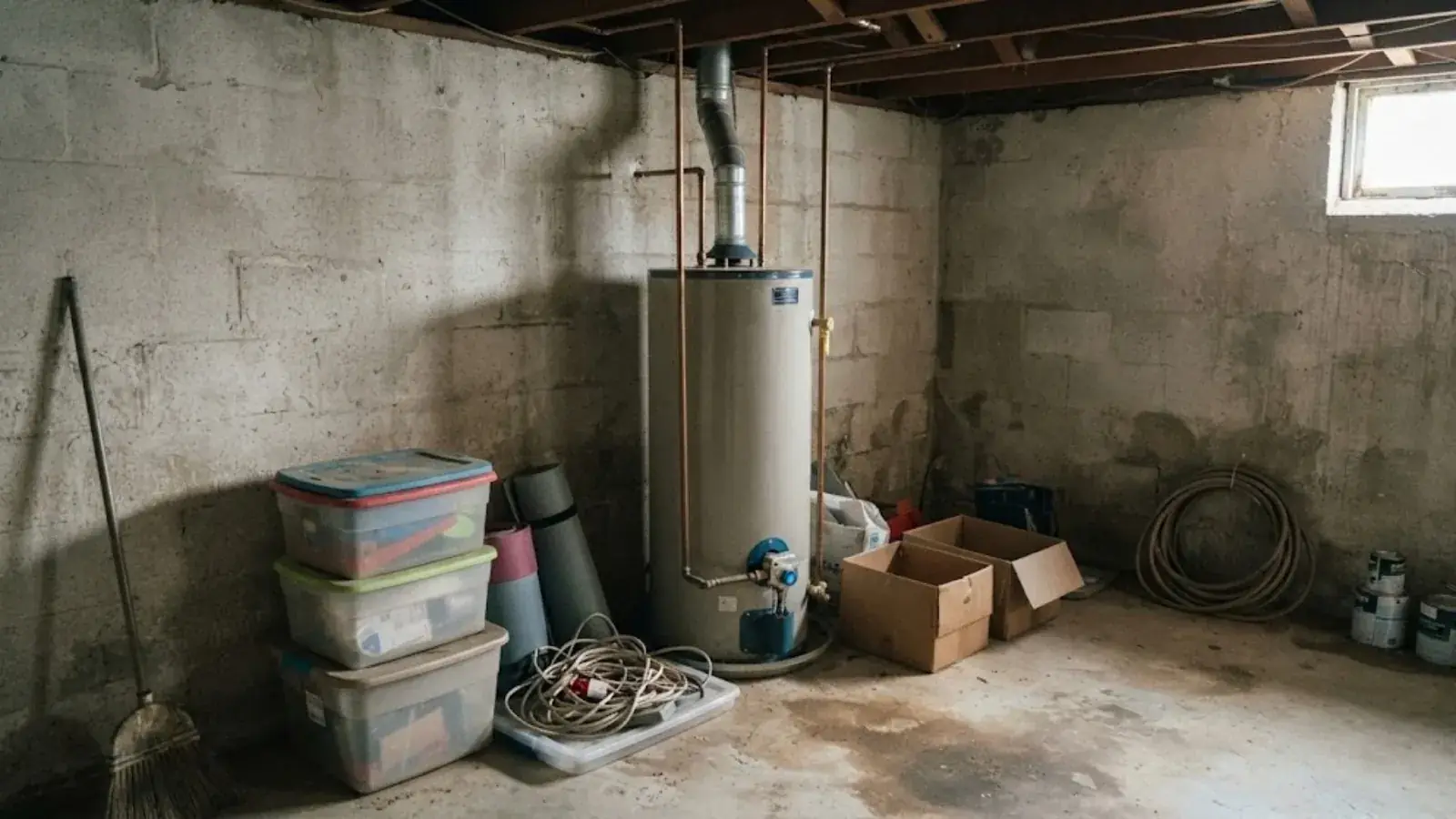
Water heater failed or leaking? Start here
Water on the floor around a tank is an urgent problem, and the 24/7 line is staffed on nights, weekends and holidays for exactly this. While you wait, shut off the cold supply valve above the tank and turn off the power at the breaker, or set a gas unit's control to off. Then stop more water from spreading by moving boxes and rugs out of the way.
Water heater replacement means removing a failed tank and fitting a new one on the same hookups, with the supply, relief valve, venting or wiring and drain handled correctly. Most replacements happen because the steel tank has corroded through, and a shell leak cannot be patched from the outside.
Is it the water heater or something else?
Not every wet spot under a heater comes from the tank. Condensation, a loose fitting and a weeping relief valve all look alike at first glance.
- Water pooling under the tank with the pan or floor wet all around the base, which usually points to a failed tank shell.
- Drips only at the pipe connections on top, which can be a fitting that tightens or replaces without a new tank.
- A steady trickle from the relief valve discharge pipe, which can mean high pressure or a worn valve.
- Rust-colored hot water only, with cold water clear, which points at the tank interior.
- A rumbling or popping noise during heating, which is sediment baked onto the bottom of the tank.
- No hot water at all with no leak, which may be a control, element or igniter problem and not a dead tank.
If the leak is clearly from a fitting, a repair visit may cost far less than a new unit. If you cannot tell where the water starts, tell the dispatcher what you see and the right plumber will bring both a tank and parts.
Replace or repair: the decision table
Three questions settle most cases: how old the heater is, where it leaks and how many repairs it has already needed.
| Situation | Usually points to | Why |
|---|---|---|
| Leak from the tank body or bottom | Replace | Corroded steel cannot be sealed |
| Leak at a pipe fitting or valve | Repair | The tank itself is still sound |
| Tank 10 to 15 years old and failing | Replace | Parts rarely justify the cost |
| Tank under 8 years old, element or thermostat out | Repair | The tank has life left |
| Third repair in a short span | Replace | Failures tend to stack up |
| Rusty hot water and sediment noise | Replace if flushing fails | The interior may be breaking down |
Age is on the data plate on the side of the tank, where the serial number often encodes the build date. Read it to the dispatcher and it helps decide the truck load before anyone leaves.
Leaking tank: what to shut off before the plumber gets there
A tank can hold 40 to 50 gallons, and a failed shell can release most of it onto the floor. These steps limit the damage.
- Close the cold water supply valve on the pipe entering the top of the tank. A quarter turn handle in line with the pipe is open, across the pipe is closed.
- Switch off the breaker for an electric heater, or turn a gas unit's dial to off. Do not step into standing water to reach a panel.
- If the floor around the tank is flooded and an outlet or power strip is wet, stay out and shut off power at the main breaker instead.
- Move anything stored on the floor nearby, and take photos of the damage for your insurer.
- Tell the dispatcher whether the heater is gas or electric, and whether it sits in a garage, closet, attic or basement.
What local water does to a tank
Hardin County Water District No. 1 (HCWD1) draws Radcliff's supply from Pirtle Spring and describes the water as hard because of contact with rocks and rocky soils. It does not publish a hardness figure in its latest quality report, so test your own tap and ask HCWD1 for its annual water quality report.
Hard water leaves mineral sediment on the bottom of a tank. Sediment insulates the burner or element zone from the water, makes the unit work harder and can speed up corrosion at the base. A yearly drain and flush, plus an anode rod check, is the cheap habit that often adds years to a tank, so ask about both when you schedule the new install.
No hot water after an outage is a different problem
Radcliff and the rest of Hardin County saw ice storms in November 2018 and February 2021, and outages after storms are the other common reason for a sudden cold shower. If the power came back and the heater is dry underneath, you may only need a breaker reset, a tripped high-limit button or a relit pilot. That is a repair, not a replacement.
A tank that went through a hard freeze in an unheated garage can also crack a fitting or split a supply line while the shell stays fine. Tell the dispatcher about the outage and any freezing so a plumber arrives prepared for the right job.
Tank, tankless or heat pump
A replacement is a good moment to ask whether the same type of heater is still the right one.
| Type | Strength | Trade-off |
|---|---|---|
| Standard tank | Simplest swap, uses existing hookups | Standby loss and finite hot water |
| Tankless | Endless hot water, small footprint | Bigger install, scale care in hard water |
| Heat pump (hybrid) | Low electric use, very efficient | Needs air space, makes noise and cool air |
Our tankless water heater page explains the descaling and venting side in more detail. Rebate programs change often, so ask the manufacturer or your electric provider instead of relying on a number from us.
Picking a size
As a rule of thumb, a household of one or two does well with a 30 to 40 gallon tank, three to four people usually need 40 to 50 gallons and a busy house with a large tub wants 50 gallons or more. The first hour rating on the yellow label matters more than the raw tank size.
Moving from gas to electric or the reverse changes the work. Gas needs a vent path and the right gas connection, and electric needs a circuit of the right size at the panel, so confirm fuel before the truck rolls. Switching fuel type often adds time and parts.
What a replacement visit includes
The sequence below is what a typical swap looks like. Details change with the home and the unit.
Confirm the cause
The plumber traces the water to the tank and checks the supply, the relief valve and the venting or wiring.
Drain and disconnect
The tank is shut down, drained to a safe spot and disconnected from water, gas or power.
Set the new unit
A drain pan goes in where a leak would reach finished floors, and new flex connectors and shutoff valves replace tired ones.
Connect and vent
Gas models get a leak check at the joints, and the vent path is verified for a safe draft.
Fill, test and explain
The tank fills before power or gas goes on, the relief valve discharge is checked and the controls are set for a safe temperature.
Old tank removal is part of the job to confirm on the call. If your install involves new venting, a gas line change or a spot that needs a pan or a new platform, our water heater installation page covers those details.
What moves the cost of a replacement
The final number is stated before work starts. These are the factors that push it up or down.
A larger tank, a tankless unit or a heat pump costs more than a like-for-like standard tank. Fuel type matters too.
A new vent run, a larger gas line or a new circuit adds parts and labor that a straight swap does not need.
An attic, a tight closet or a basement with stairs takes longer than a garage with a flat floor.
Expansion tanks, pans, relief piping and valves may be needed. Permit rules vary, so ask the city building department.
Most homeowner policies cover sudden burst or accidental discharge but not wear and tear on the heater. Photograph the damage and ask your insurer what applies.
Rental houses near Fort Knox
Radcliff borders Fort Knox, and the steady turnover of military families means many homes are rentals with owners who live elsewhere. A landlord can approve a replacement by phone, and the plumber can coordinate access with the tenant. Tell the dispatcher who pays, who lives there and who can open the door.
We also serve nearby towns, so owners in Vine Grove or Elizabethtown can ask for the same service on the same line.