
Snaked it, and it stuck again. Now what?
Most people look for hydro jetting after a cable has already failed them. The sink cleared for a week, or the tub drained until the next load of laundry, and now the whole house is slow. If water is backing up while you read this, the 24/7 line is open on nights and weekends, and the first call is about stopping water use, not selling a jet.
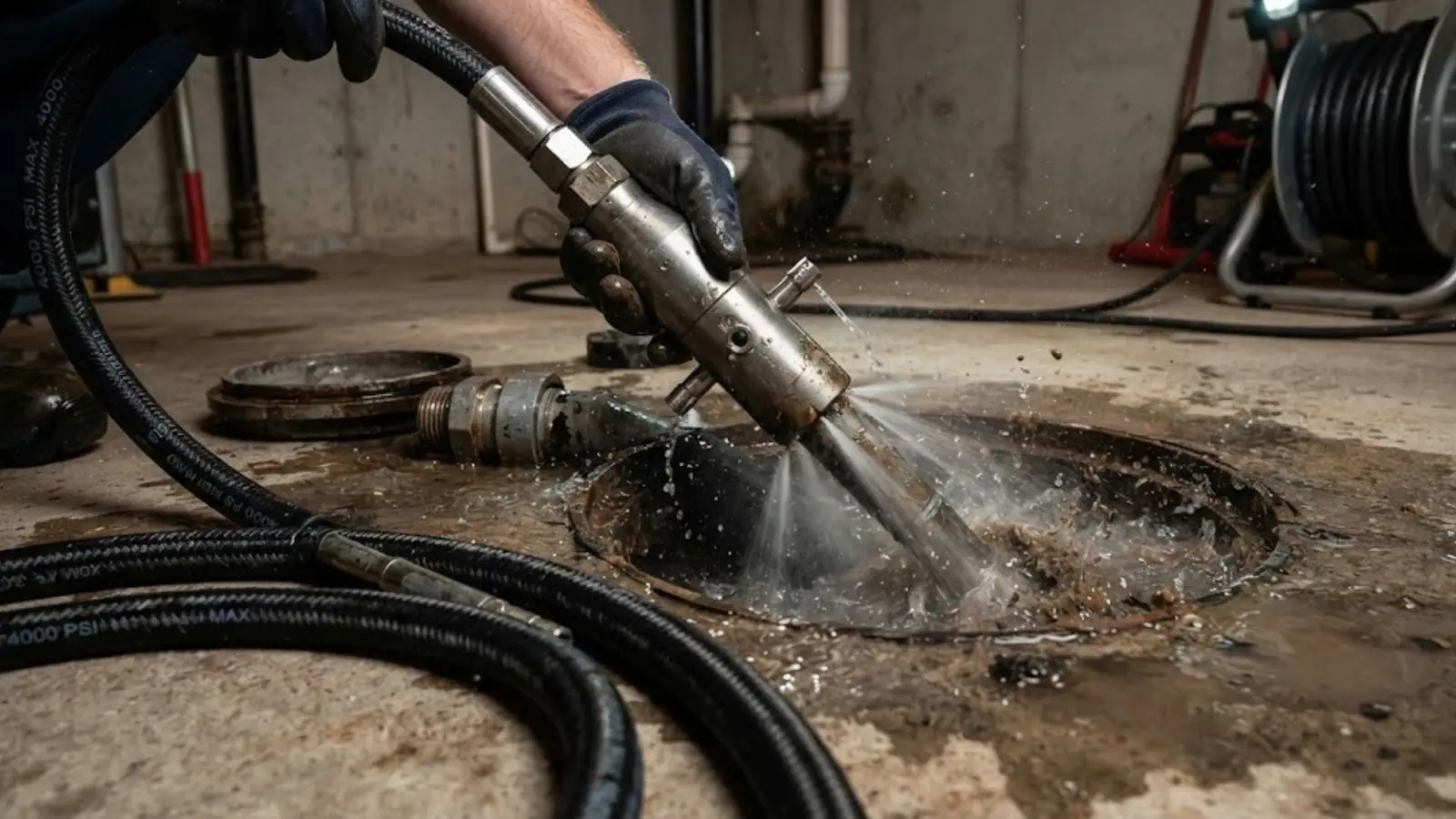
Jetting is a cleaning method. A hose with a special nozzle goes into the line and sprays water backward and sideways at high pressure, pulling itself forward and scouring the wall as it goes. The right order is to find out what is in the pipe first, then pick the tool.
What people notice before they search for it
These patterns tend to bring someone to this page.
- A drain clears with a cable and slows again within a few weeks
- More than one fixture is slow or gurgling at the same time
- A kitchen line that smells of old grease even after cleaning
- Water that rises in the lowest tub or floor drain when the washer runs
- A cable that comes back with roots, slime or a coating of grease on it
- A drain that clears briefly and then sits at half speed
Each of these suggests a buildup lining the pipe rather than a single plug. That is the situation where a jet earns its cost. A pipe that is cracked or collapsed looks the same from the fixture, which is why the camera comes first.
Why the camera goes in before the jet
A small camera on a flexible rod shows what the water will hit. Grease, scale and soft debris are good candidates for jetting. A break, a section that has shifted out of line or a belly where water pools are not, and blasting a failing pipe can push soil into the opening or loosen a joint that was barely holding.
Knowing this up front also sets expectations. If the camera shows roots entering at a joint, the jet clears them for now, and the pipe still needs a repair to stop them from returning. Our page on camera inspections of the sewer describes what the footage can and cannot show.
Cable, camera first, or jet: how they compare
No single tool is best. This table lines up what each one is for.
| Method | Best for | Limit |
|---|---|---|
| Cable or snake | A soft plug or one object near a fixture | Leaves buildup on the pipe wall |
| Camera first | Repeat clogs, unknown cause, older lines | Finds the problem but does not clear it |
| Hydro jet | Grease, scale, silt and heavy buildup | Cannot fix a break, offset or collapse |
| Jet after camera | Confirmed buildup on a sound pipe | Needs access to the line, such as a cleanout |
What jetting cannot fix, and pipes to be careful with
Water pressure does not repair anything. A collapsed section, a joint that has slipped apart or a pipe with a large gap needs repair of the sewer pipe of some kind. Jetting through such a section can wash soil into the line and make the blockage worse.
Old cast iron deserves caution. Decades of rust form a rough scale inside, and the metal under it can be thin. A plumber sets a lower pressure and a gentler nozzle for old pipe, and may decline to jet at all if the camera shows the wall flaking badly. Clay pipe with loose joints gets the same careful treatment.
Thin-walled or heavily patched pipe is the other case. If the plumber recommends a cable and a camera instead of a jet, that is a judgment about your pipe, not a lack of equipment.
Why backups bring jetting into the picture
A sewer backup is the usual emergency behind an urgent call. Wastewater has nowhere to go, so it rises to the lowest opening in the house. A cable restores flow quickly in many cases, and a jet follows when the camera shows heavy coating along the main line.
When the line is running again, the plumber confirms flow with water at the fixtures. If your home is on a septic system instead of city sewer, tell the dispatcher at the start. The plumber sent and the method used depend on it. For the main line itself and what to avoid during a backup, read about cleaning out the sewer line.
Local conditions that load pipes
HCWD1 operates the Radcliff sewer system, and the district says its water is hard because it passes through rock and rocky soil. Hard water can leave mineral scale on pipe walls over time, and scale gives grease and soap something to cling to. That is a reason older drain lines build up faster, and jetting removes scale that a cable passes over.
Homes in Vine Grove, which HCWD1 also supplies with water, can see similar buildup in old pipes. Homes toward Elizabethtown may be on a different utility, which depends on the service address. We are not claiming that roots are a common problem here. The camera decides that for each line.
What affects the price of a jetting visit
A price is given before work begins. These are the main variables.
A longer run or a wide main takes more time and water. A short branch line is quicker.
A cleanout lets the hose enter directly. When there is none, the plumber may need to pull a toilet or work through a vent, and that adds labor.
A light coating needs one pass. Thick grease or heavy scale takes repeated passes and more time.
A camera look before the jet and a second look afterward confirm the result. Each is a separate step.
Same-day appointments are scheduled in the normal day. A middle-of-the-night call is an emergency dispatch, and the price reflects that.
Most homeowner policies cover sudden accidental water damage but not wear or a gradual buildup. Ask your insurer before assuming a claim will apply, and photograph any wet areas before cleanup.
Stay safe while you wait
A few small steps protect your floors and your health.
- Stop all water use, including the washing machine and dishwasher.
- Keep children and pets out of any room where wastewater has come up.
- Stay out of a flooded basement if outlets or appliances are in the water, and tell the dispatcher so the emergency is handled with that in mind.
- Skip chemical cleaners. They do not clear grease or scale well, and the plumber then has to work around them.
- Write down which fixtures were slow and when it started.