
Is it groundwater, condensation or a pipe?
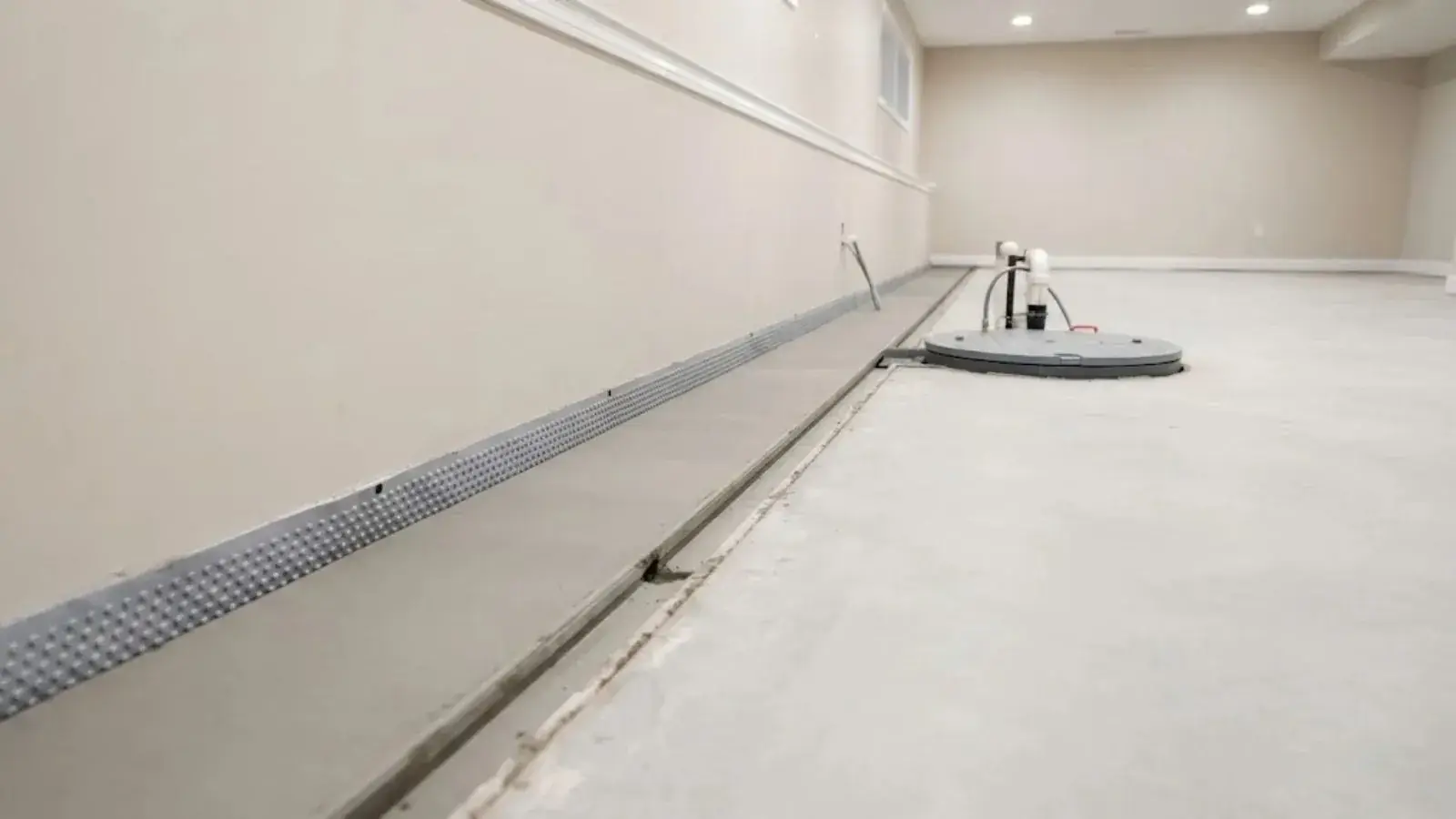
Basement waterproofing is the work of keeping groundwater and surface water out of the lowest level of a house, usually through drainage, a sump and sealed openings. The plumbing side of that job starts with a diagnosis, because a wet basement has at least four possible sources and only some of them need waterproofing.
Look at when and where the wetness shows up. Water at the base of a wall after heavy rain points to groundwater or surface runoff. A damp patch that stays the same in dry weather points to a pipe. A cold wall that sweats in summer points to condensation. Each result sends the fix in a different direction, and guessing wrong is how people end up paying twice.
Urgent versions of this problem, such as water rising on the floor during a storm, go through the 24/7 line and the crew on our sump pump page.
What the plumber can fix and what other trades handle
The plumbing scope is interior drain tile, sump pit and pump, discharge piping, sealing pipe penetrations through the wall and finding supply or drain leaks. Grading, gutters and downspout extensions are often the cheapest fixes and a homeowner can start on them.
Wall coatings are a different category. Paints and liquid rubber membranes can stop dampness that comes through porous masonry, but a coating alone does not stop water that is pushing through under pressure, because the water lifts the coating off the wall. Structural cracks, bowed walls and settling need an opinion from a structural professional, not a sealant. We will tell you when the problem falls outside plumbing.
Radcliff's karst and what it means for your basement
The 2023 Lincoln Trail hazard mitigation plan says Radcliff drains into 86 known sinkholes. The Quiggins Sinkhole in the Happy Valley watershed flooded in 2008, and FEMA's assessment says as little as one inch of rain over six hours could cause major flooding there. A grant-funded project is building four retention basins and expanding a fifth to handle the water.
For a homeowner, the lesson is about timing. Moisture problems in this area tend to arrive with intense rain, not with slow wet seasons, so a basement that was dry for years can flood in one storm. Kentucky Geological Survey guidance also warns against using sinkholes as dumps, which is worth remembering if you are tempted to send roof or sump water toward a low spot on your lot.
Not every Radcliff home has a basement. Slab houses and crawlspaces have different moisture problems and different fixes, and the table below separates them.
Rule out a plumbing leak first
A leaking supply line can mimic groundwater, and the water district gives you an easy way to check. Hardin County Water District No. 1 publishes this test:
Turn everything off
Close every faucet and appliance, including the ice maker.
Read the meter
Note the number and the red leak indicator arrow.
Wait 30 to 60 minutes
Use no water during that time.
Read again
If the reading changed, water is leaking somewhere past the meter, and the basement may be a symptom.
Call for tracing
A listening and thermal survey finds the pipe, as described on our leak detection page.
Find the source with a simple checklist
Work through these before you spend anything:
- Foil test: tape a square of aluminum foil tight to the wall and leave it for a day or two. Moisture on the room side means condensation. Moisture behind the foil means water is coming through the wall.
- Downspouts: check that each one empties several feet from the foundation and not at the wall.
- Grading: the ground should slope away from the house, not toward it.
- Window wells: look for debris, standing water and cracks around the frame.
- Plumbing: check for wet spots near the water heater, washer connections and any basement bathroom.
- Sump: if you have a pit, check that the pump runs and the outlet is clear.
- Timing: note whether water appears only after rain or on dry days.
Moisture source and the usual fix
This pairs each source with the most common remedy and who usually does the work:
| Moisture source | Usual fix | Who handles it |
|---|---|---|
| Roof and downspout runoff | Extend downspouts, clean gutters | Homeowner or gutter contractor |
| Poor grading | Regrade away from the foundation | Grading contractor or excavator |
| High groundwater at the footing | Interior drain tile and sump pit | Plumber, sometimes with a basement specialist |
| Seepage through porous block | Interior sealant after the water is controlled | Waterproofing contractor |
| Cracks that move or widen | Structural evaluation first | Structural professional |
| Condensation on cold surfaces | Ventilation and dehumidifying | Homeowner or HVAC |
| Supply or drain pipe leak | Pipe repair | Plumber |
| Slab or crawlspace with no basement | Vapor barrier, crawlspace drainage, pump if needed | Depends on the space |
Is a sump pump enough?
A sump pump removes water once it reaches the pit. It does not stop water from reaching the wall, and it needs a pit that is connected to drain tile or collects from the floor edges. Where water is entering at one corner after heavy rain, a pit with tile along that wall is often enough.
Where water is entering across the whole floor, or the house sits in ground that stays saturated, a pump alone may run constantly and still leave dampness. In that case the drainage around the foundation needs attention, and the pump is part of a system. The pump side, including backup power, is covered under pump repair and replacement.
Sewer and drain lines also matter
A floor drain that backs up after rain is not the same problem as groundwater, though it shows up as the same puddle. If water is coming up through a floor drain, the sewer or the drain line may be overloaded or blocked. Cleaning the sewer line is the right first step then, and a camera shows whether roots or a collapse are involved.
Tell the dispatcher whether you are on city sewer or a septic tank, so the right plumber is sent.
What moves the price of a waterproofing project
A clear price is given before work starts. These factors drive it:
Interior drain tile is installed along the wall, so more linear feet mean more labor and more material.
Cutting a trench through a concrete floor and restoring it is a major share of the job.
A new pit, a higher-capacity pump or a battery backup each add parts and labor.
A long run to a safe outlet costs more than a short one.
Finished walls or flooring need to be opened and restored, which adds a separate scope.
Planning the work and nearby service
Waterproofing is planned work, so book it when the basement is dry enough to inspect and before the stormy season. If you are adding drainage as part of a remodel, bring it up when you talk about new plumbing installation so the trenching and piping happen once.
We work in Radcliff and nearby Hardin County towns, including Vine Grove, which sits just west of the city.