
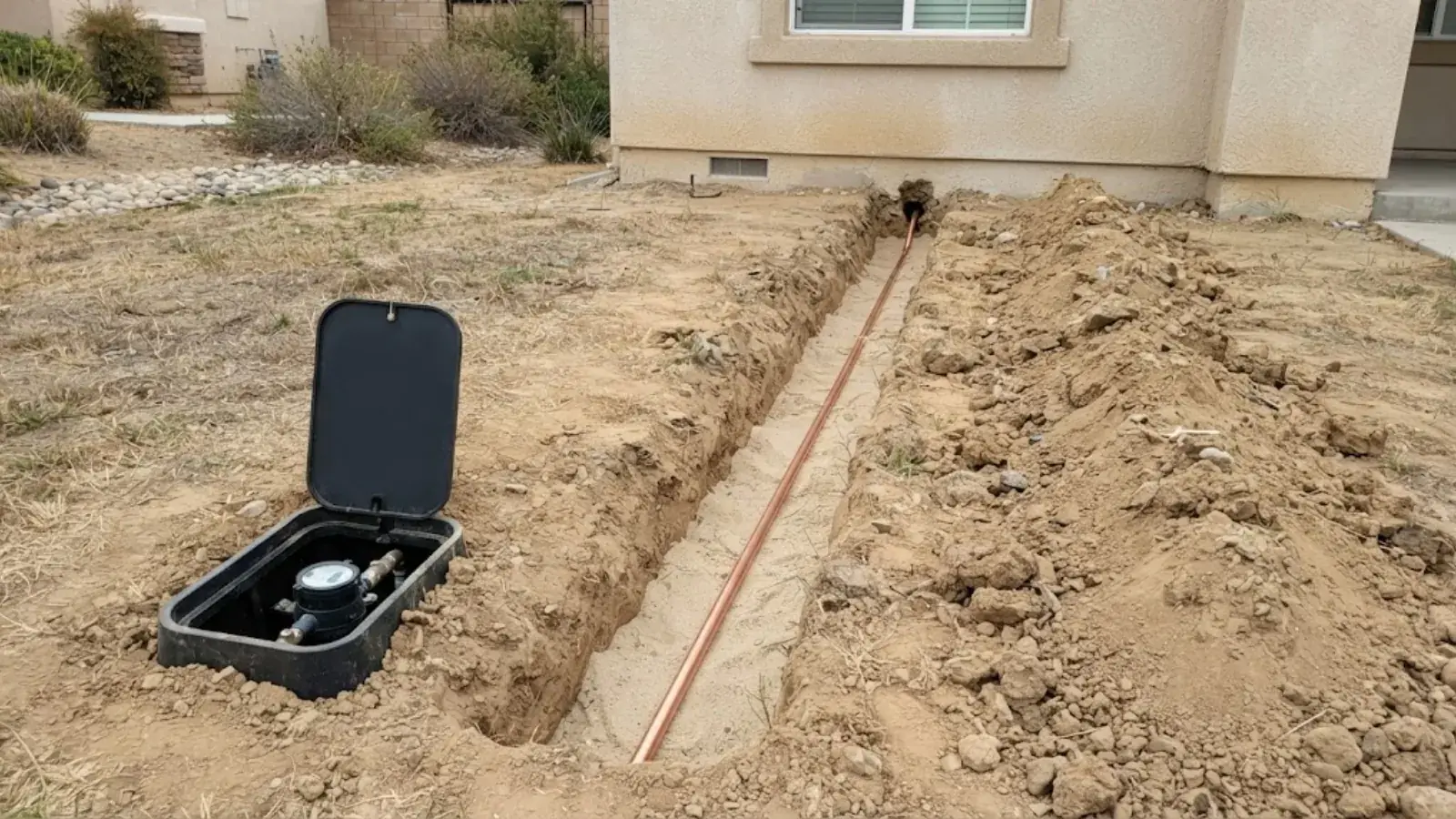
Water line emergency: what a failing service line looks like
A water service line is the buried pipe that brings water from the district's meter to the point where it enters your house. When it cracks or corrodes, water escapes underground and you may never see it directly. Our 24/7 emergency line sends a licensed plumber out nights, weekends and holidays when that line fails, and same-day appointments are available when the break is slow.
Start by closing the main valve at the house. If a geyser is rising from the yard or the street side, stay back from it and do not touch the meter, which belongs to Hardin County Water District No. 1. HCWD1 supplies Radcliff and Vine Grove, so the district can tell you where its side of the line stops.
Who owns which part of the line
In many systems the utility owns the meter and the pipe up to it, and the homeowner owns the pipe from the meter to the house. Details vary, such as where the meter sits or how the connection was built, so ask HCWD1 where its responsibility ends before any digging starts.
This matters for cost and for permission. If the break is on the district's side, the district fixes it. If it is on yours, the repair is a plumbing job, and a licensed plumber can tell you the exact point of failure in writing so there is no argument about it.
Signs the line under the yard is failing
HCWD1's own list of underground-leak clues is a good place to start. Walk the yard from the meter to the house and look for these:
- A strip of grass that is greener or taller than the rest of the lawn.
- Unexpected vegetation or dark patches where fungus grows in wet soil.
- A soft or muddy spot with no rain or irrigation to explain it.
- A meter that keeps moving after every fixture inside is shut off.
- A sudden drop in pressure at every tap in the house.
- A meter box that fills with water again after you empty it.
Any one of these is a reason to run the meter test below. Several together nearly always mean the line has a break.
Proving it with the meter
The district's method works for a service line too:
Stop all use
Turn off every fixture and appliance, including the ice maker and the irrigation system.
Note the reading
Record the meter number and look at the red leak indicator arrow.
Wait 30 to 60 minutes
Do not flush or run any water during this time.
Compare
A changed number or a moving arrow means water is moving somewhere past the meter.
Close the house main and check again
If the meter still moves with the house shut off, the leak is in the buried line.
How an underground leak is located
Water from a buried break travels along the path of least resistance, often along the pipe trench, so the wet spot at the surface can sit well away from the damage. Digging at the wet spot is a frequent and expensive mistake.
A plumber walks the line with a ground microphone and listens for the hiss of escaping water. Where the pipe is plastic and quiet, a pipe locator or a tracer helps follow the route before listening starts. A pressure test on the isolated line confirms that it is losing water and that the loss is not at a fixture.
Once the sound narrows to a few feet, a small test hole confirms the break before the real excavation. Our page on finding hidden leaks covers these tools in more detail.
Spot repair, trenchless or a new trench
The right route depends on how many failures the line has and what sits on top of it:
| Option | Best for | Trade-offs |
|---|---|---|
| Spot repair | One clear break in sound pipe | Smallest dig, but a worn line can fail again nearby |
| Trenchless replacement | A line under a driveway, walkway or mature landscaping | Less surface damage, needs suitable pipe path and entry points |
| Open trench replacement | Multiple breaks, very old pipe, or clear access across the yard | Most disruptive, but the whole line is renewed |
| Reroute | A line that runs under a structure | Avoids the structure, adds new pipe length |
Digging is not always needed. A line that fails only at the house wall or inside a meter box can sometimes be fixed with little excavation.
Pipe materials in service lines
These are the materials a plumber meets most often:
| Material | Common problems | Replacement note |
|---|---|---|
| Copper | Pinholes from corrosion, joint failures | Durable, and a copper line is often repaired in sections |
| Polyethylene | Splits at fittings, damage from rocks or digging | Flexible and easier to pull through in trenchless work |
| Galvanized steel | Rust inside the pipe, shrinking flow, repeated leaks | Usually worth replacing rather than patching |
Low water pressure in the whole house
A line leak is only one reason pressure drops. Other causes include a pressure regulator that is failing, a main valve or meter valve that is partly closed, and mineral scale narrowing older pipe. HCWD1 draws from Pirtle Spring groundwater and says the water is hard, so scale in fixtures and old steel pipe is a fair suspicion.
The plumber checks pressure with a gauge on a hose bib, then compares it with the reading on a second outlet. A low reading at every tap, plus a moving meter, points to the buried line. A low reading with a still meter points to the regulator, a valve or the pipe itself. Test your tap and ask HCWD1 for its annual water quality report if scale is a concern.
What a repair visit looks like
A line repair follows a predictable order, so you can plan around it:
Locate
The plumber confirms the break with listening gear, then marks the dig area.
Call before digging
Buried utilities are marked first through the state's one-call service, so ask the plumber about it.
Excavate and cut out
The failed section is exposed and removed.
Repair and test
New pipe is joined and the line is pressure tested before backfill.
Restore
Soil is returned and compacted, and surface repair is discussed.
What moves the price of a water line repair
You get a clear price before work starts. These factors shape it:
A short, shallow trench is quicker than a long run through a yard. Rocky soil adds labor.
A driveway, a deck or tree roots complicate access and may favor trenchless work.
The new pipe and fittings differ for copper and polyethylene, and a mismatch with old pipe needs transition fittings.
One break is a spot repair. Several breaks along the same line usually mean replacing the whole length.
Backfill is part of the repair. Reseeding, concrete or landscaping is a separate decision.
Asking the district about your bill
A long underground leak can run the bill up before anyone notices. HCWD1 has a leak adjustment process, and it starts with finding the cause of the usage past the meter. A qualifying leak may then get an adjusted rate on the non-leak usage, and the sewer portion may be adjusted if the leaked water never entered the sewer. The details are in the tariff, so call the district before repair and keep the plumber's written finding.
While you wait for a visit, the burst pipe page explains how to shut off the house and what to photograph.
New lines and planned replacement
Not every water line job is urgent. A galvanized line that has been losing pressure for years, a line that must move for an addition or a new connection to a detached building are planned jobs. The same crew handles them as new plumbing installation work, and if interior pipes are failing as well, repiping looks at the house as a whole.
For towns near Radcliff, Vine Grove and Elizabethtown get the same emergency line, and Vine Grove shares the same water district.