
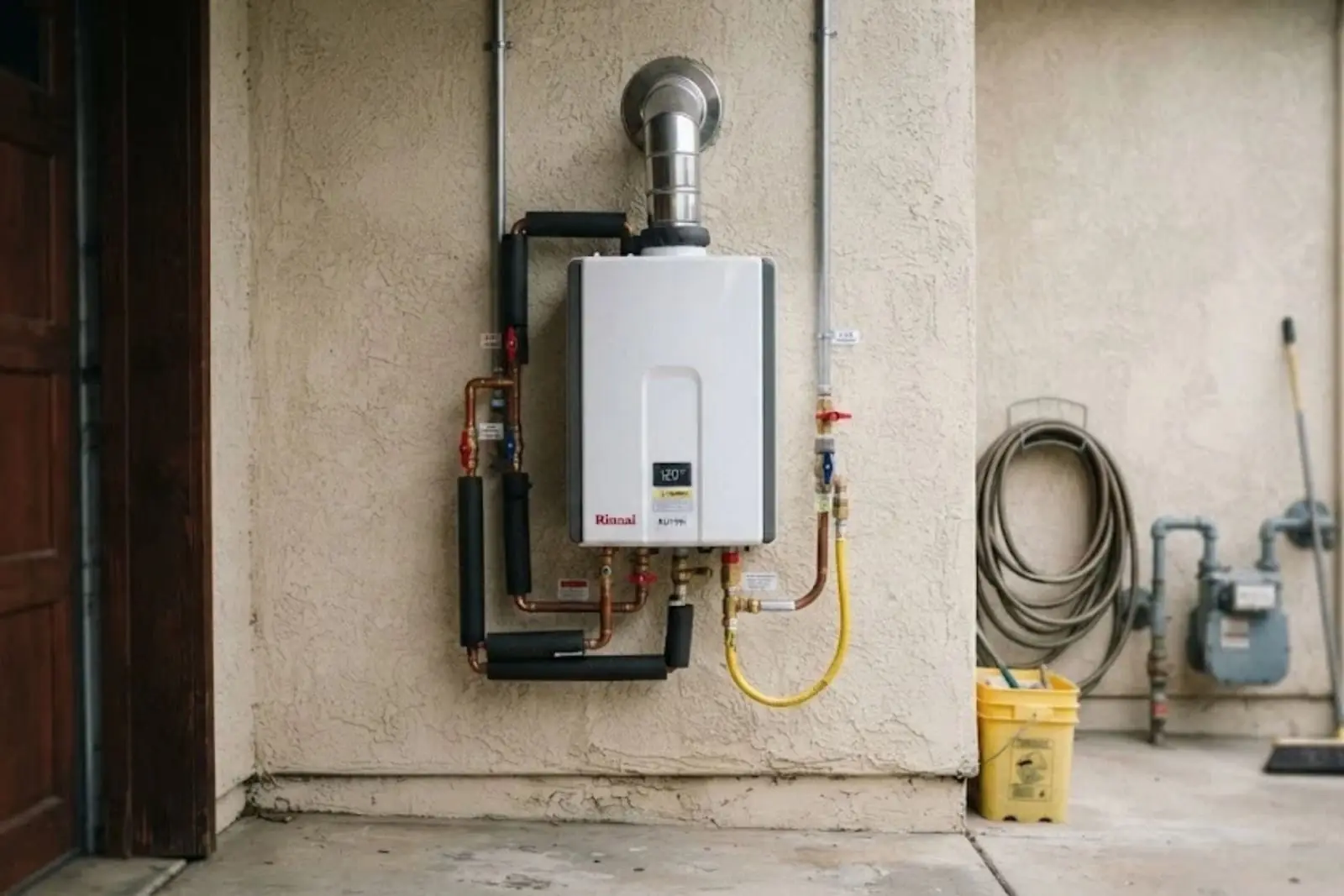
Yes, with conditions
A tankless unit is light and compact compared with a tank, so an attic is physically possible. The trouble is everything around it. The unit needs a legal exhaust path, a way to handle condensate, protection from freezing, a leak plan and room for someone to service it on their back in a hot space.
If your attic cannot meet those five, the heater belongs somewhere else. Many homes have a better spot in a garage, utility room or closet, and moving the location is a design decision worth making before you buy hardware.
Five things an attic must provide
Run through these before you ask anyone to quote the job.
- A vent route out through the roof or a gable wall, using the vent material the manufacturer's instructions specify.
- A floor that can carry a service person and the unit's mounting, with solid decking around it and not only joists.
- A drain pan with its own drain line to a place where leaking water will be noticed.
- A safe condensate path if the unit is a condensing model, with a neutralizer if the manual calls for one.
- A clear, lit, walkable route from the attic hatch to the unit, with working room on all sides.
Venting: the first deal-breaker
Gas tankless units move combustion gases out through a sealed or semi-sealed vent. Condensing models often use plastic pipe and run cool exhaust, while non-condensing models usually need metal vent rated for higher temperatures. The correct pipe, the maximum length and the number of elbows come from the manufacturer's installation manual, not from a rule of thumb.
In an attic that run often has to climb through insulation and a roof deck. Each penetration needs proper flashing, and the pipe must stay clear of insulation and framing by the distance the manual states. A vent that is too long or has too many bends will make the unit throw error codes or shut down.
An electric tankless heater has no exhaust at all, which is why people sometimes think of it for an attic. The trade-off is electrical load, covered below.
Weight, drain pan and leak protection
The unit itself is far lighter than a tank, but a full-size tank is not the only weight concern. Mounting hardware needs solid framing behind it, and anyone who services the unit adds their own weight and tools to the attic floor.
The bigger concern is water. Any leak in an attic ends up in a ceiling, usually unseen until the stain spreads. A pan under the unit with a drain line that terminates where someone will notice is the standard approach. Some owners add a water sensor with an alarm and a shutoff valve that closes when the sensor gets wet.
Whoever installs it should also isolate the unit with service valves, so a plumber can flush it or shut it off without draining half the house.
Radcliff winters and hard water in the attic
The regional hazard mitigation plan lists ice storms in the Hardin County zone in November 2018 and again in February 2021. Outages often follow ice, and a tankless unit with electronic ignition and freeze protection depends on power. If you put one in an attic here, plan for what happens to the water lines during a long outage.
Hardin County Water District No. 1 also says its spring-fed supply is hard. Scale builds up inside the narrow passages of a tankless heat exchanger, and it is much harder to service in an attic. Test your tap and ask HCWD1 for its annual water quality report, then ask your installer about a flush schedule and isolation valves that make that flush possible.
Source type: Regional hazard mitigation plan and HCWD1 utility FAQ.
Attic suitability at a glance
This table shows how each concern changes by unit type.
| Concern | Gas, condensing | Gas, non-condensing | Electric |
|---|---|---|---|
| Exhaust | Plastic vent, long runs possible | Metal vent, higher temperature | None |
| Condensate | Yes, needs drain and often a neutralizer | Minimal | None |
| Freeze risk | Water, condensate line and vent | Water lines and vent | Water lines |
| Fuel or power | Gas line sized for the load, plus power | Gas line sized for the load, plus power | High-amperage circuit, often large |
| Service access | Tight attic makes this hard | Tight attic makes this hard | Easiest to service |
Electric looks easiest on paper. But the amperage some whole-house units pull can exceed what an older panel can supply, which is why an electrician's input matters before you commit.
Freeze risk and what to do about it
An unconditioned attic can drop well below freezing in a hard cold snap. Pipes, the unit's heat exchanger and the condensate line are all vulnerable. Many tankless models include freeze protection, but that protection usually needs electric power to run, so it does nothing during an outage. Insulating the pipes and keeping the unit within a heated envelope is the more dependable approach.
Gas supply and electrical needs
A gas tankless unit demands a lot of fuel when it fires. The pipe feeding the attic must be sized for the unit's maximum input plus every other gas appliance on that line. An undersized line produces weak heat and nuisance shutdowns, and it is often the reason a swap that looked simple becomes a bigger job.
Even a gas unit needs a power connection for the controls, fan and ignition. An electric whole-house unit may need several large breakers. In either case, ask a licensed plumber and an electrician about your panel and supply before you commit to the attic.
Our tankless page explains how these units are sized, and the installation notes describe what an installer checks on arrival.
What you can and cannot do yourself
A homeowner can usefully prepare the space. The installation itself is licensed work in most cases.
Measure the route
Check the hatch size, the path to the unit and the clearances, since many units will not fit through a standard hatch with their boxes on.
Find the vent exit
Mark where a vent could leave the building, away from soffit vents and windows.
Look at the panel
Note the main breaker size and free slots so an electrician can judge the load.
Check the gas meter and line
Identify the pipe size and what else is on the line, then share this with the installer.
Ask about a better location
Have the plumber compare the attic with a garage or utility closet before you spend money.
Safety rules that apply to any attic install
If you ever go up to look at an existing unit, keep these in mind.
- Step only on framing or solid decking, never on ceiling drywall or insulation.
- Smell gas and you leave the house, then call the gas utility or 911 from outside.
- Turn the unit off at its control before touching any connection, and shut the gas valve at the unit.
- Never block the vent terminal or tape over an exhaust pipe for any reason.
- Do not work in a hot attic alone, and avoid it in peak summer afternoons.
Frequently asked questions
It can, since there is no exhaust to manage. The catch is the electrical load. Many whole-house electric units draw a lot of amperage and need several dedicated breakers, which an older panel may not have room for.
Water-line freeze protection and a drain pan still apply.
A condensing gas unit has to drain its acidic condensate. If that drain freezes or clogs, the unit will usually stop and show an error. Insulating the line, keeping it sloped and running it to a protected drain reduces the risk.
Ask the manufacturer's manual what the unit does when the drain is blocked.
It is the safest approach. A pan with a drain line that exits somewhere visible limits ceiling damage if a fitting weeps. Many installers add a leak sensor or an automatic shutoff as well.
Whether the pan is required can depend on local rules, so ask the city building department.
Yes, compared with a garage or closet. Flushing scale, replacing an igniter or clearing a vent all mean hauling tools through a hatch and working in a cramped, hot or cold space. Service valves and a lit, clear path make a big difference.
Some owners decide that cost over the years outweighs the floor space they save.
It can if the attic gets cold enough and the unit's electric freeze protection is not running. The regional plan records ice storms in the Hardin County zone in 2018 and 2021, and outages often follow ice, so this is a realistic scenario here.
Insulate the lines, and ask your installer how to drain the unit before a long outage.
Yes. If you live in Vine Grove, see our page for an emergency plumber serving Vine Grove. For Elizabethtown, our Elizabethtown service page explains coverage. Same-day appointments are offered when available.