
Confirm there is a leak first
The most reliable first test uses your water meter. Shut off every fixture and appliance in the house, including the ice maker and any irrigation, so that no water should be moving. Read the meter, wait, and read it again.
If the numbers changed, or the small leak indicator on the meter face is turning, water is going somewhere. That could be a running toilet, a dripping fixture, or a pipe leaking underground. The next steps narrow it down.
Run the meter test step by step
Give yourself a quiet half hour and a pen. Do not run a dishwasher, washer or shower during the test.
Stop all water use
Close every faucet, make sure no one flushes, and pause the ice maker, humidifier and sprinkler system.
Record the reading
Lift the meter lid, note every digit and the position of the leak indicator, or photograph it.
Wait 30 to 60 minutes
Stay out of the water the whole time, then read it again.
Compare
Any change in the digits, or a moving indicator, means water is leaving the pipes somewhere.
Close the house main and repeat
If the meter still moves with the house valve shut, the leak is on the buried line between the meter and the house.
Inside leak or buried leak?
The second meter check is the key. It separates a plumbing fixture problem from a buried one.
| Result | What it means | Where to look |
|---|---|---|
| Meter stops once the house valve is closed | Leak is inside the house plumbing | Toilets, faucets, water heater, appliance lines |
| Meter keeps moving with the house valve closed | Leak is between the meter and the house | Yard, driveway, under the slab entry |
| Meter moves only when the toilet fills occasionally | Running toilet or slow fill valve | Toilet tanks |
| Meter moves only at night or when irrigation runs | Irrigation leak or stuck valve | Sprinkler zones and valves |
| Hot water bill rises, cold does not | Leak in hot line or heater | Water heater, hot lines under slab |
Radcliff meter readings and the HCWD1 leak guidance
Hardin County Water District No. 1 tells customers to shut off every fixture, read the meter, and read it again after 30 to 60 minutes. Its FAQ also describes underground leak signs as lush grass, unexpected vegetation and dark spots from fungus growth, and points to the red leak indicator on the meter.
The district's leak adjustment policy details live in its utility tariff, so ask HCWD1 before assuming a credit. It first needs the cause of the extra usage found, so keep the plumber's finding and your photos.
Source type: HCWD1 utility FAQ.
Signs in the yard and house
Buried water leaves traces, and several signs appear together.
- A patch of grass that is greener, lusher or growing faster than the lawn around it
- Unexpected vegetation or moss in one spot, even in dry weather
- Dark spots on the ground from fungus growth or soil that stays damp
- Soft, spongy or sinking ground, or water pooling with no rain
- Low water pressure, or a hissing sound near the meter or along the pipe path
- A warm spot on a floor, which can mean a leaking hot line under a slab
- A water bill that jumps without a change in how your household uses water
No single sign proves a leak. A green patch can come from a septic problem or a drainage issue, which is why the meter test comes first.
Do a pressure drop check
A plumber can confirm a leak with a pressure test. A gauge goes on a hose faucet, the house valve closes, and the plumber watches whether pressure holds. A steady drop with the valve closed points to a leak in the line.
You can try a simple version. Close the house main, wait an hour with no one using water, then open a faucet to see if pressure has dropped. It is not as precise as a gauge, but a weak flow right after opening tells you something is off.
How professionals pinpoint the break
Digging blindly wastes time and lawn. Plumbers use equipment that narrows a leak to a few feet.
| Method | How it works | Best for |
|---|---|---|
| Acoustic listening | Ground microphones and a correlator pick up the hiss of escaping water | Pressurized lines in metal or plastic |
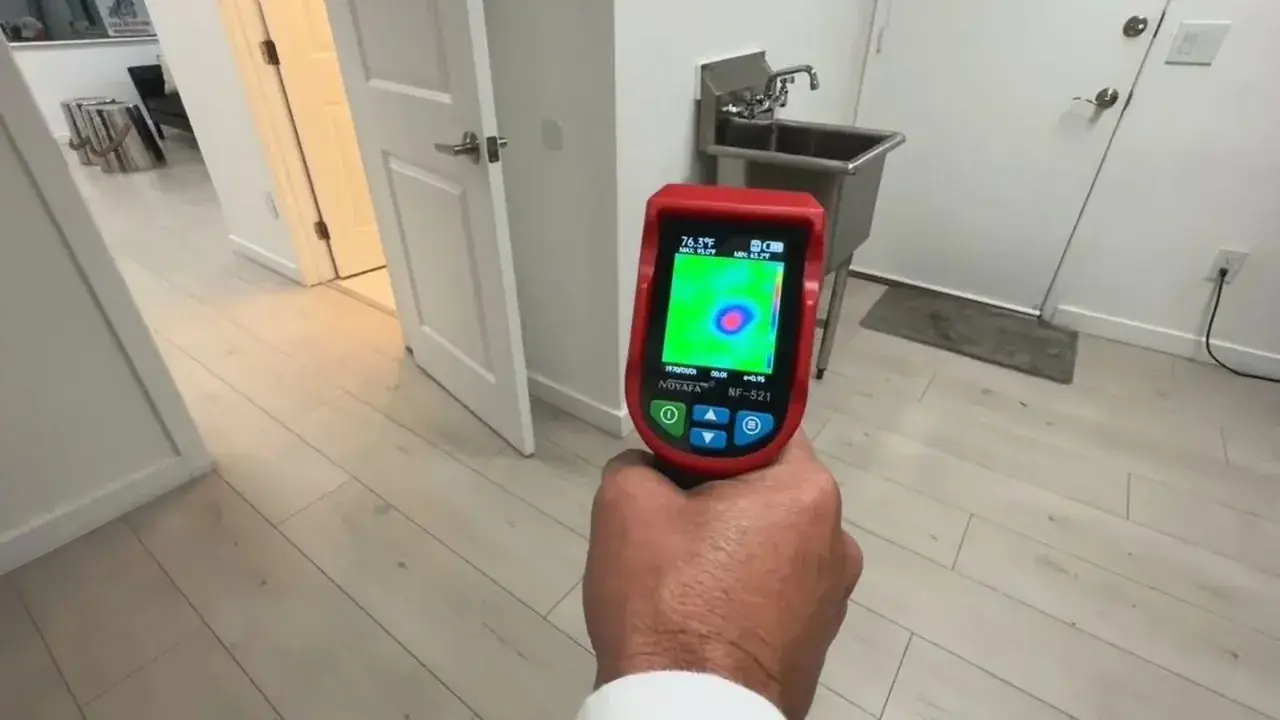
| Thermal imaging | A camera reads temperature differences from warm leaking water | Hot lines and slab leaks |
| Tracer gas | A harmless gas mix is injected, then sniffed at the surface | Quiet leaks where sound fails |
| Pipe locator | A receiver traces the buried line's path and depth | Finding where the pipe actually runs |
| Isolation pressure test | Sections of line are valved off and tested one at a time | Narrowing which run is leaking |
A plumber offering leak detection tracing should explain which method fits your line and why, and name the cost factors before the work begins.
Before anyone digs
Call 811 before any digging, even for a small hole. Gas, power and communication lines may be buried near your water line, and hitting one is dangerous. Do not dig by hand around the meter box or near the street. If water is gushing and flooding the yard, close the house valve and tell the dispatcher what the meter and valve are doing.
Repair choices once the leak is found
A short spot repair, cutting out the damaged section and splicing in new pipe, is often possible when the rest of the line is sound. A long run of old, repeatedly failing pipe may be better replaced, either by trenching or by trenchless methods that pull a new line through the old path.
Compare the options with the plumber. The number of leaks so far, the age and material of the pipe, and what sits above it, such as a driveway or a mature tree, all shape the decision. For work on the buried service line, see the water line repair page.
If the leak is already causing damage, photograph the wet areas and ask your insurer what your homeowner policy covers. Many policies pay for sudden accidental discharge and not for gradual wear, so ask before repairs begin.
We dispatch plumbers to Radcliff and also to Vine Grove and Elizabethtown.
Frequently asked questions
Yes. Water can drain into loose or sandy soil, or follow a gravel bed, and never reach the surface. That is why the meter test matters more than the lawn. A moving meter with every fixture off is the clearest sign.
It is a good early clue. The small triangle or dial spins when any water moves, even a tiny flow. Seeing it turn with all fixtures off is a reason to test further, not proof of where the leak is.
Sometimes you can hear a hiss at the meter or a hose faucet with everything off, and a screwdriver held to the pipe works as a crude stethoscope. Pros use ground microphones and correlators, which hear what you cannot.
Not usually. A slab leak shows as a warm floor, damp carpet, a musty smell or cracked tile. A yard leak between the meter and the house shows as a wet or lush spot outdoors. Both can move the meter.
Closing the house valve is a good test and a safe pause while you wait. If the meter stops, the leak is inside. If it keeps moving, the leak is outdoors.
Ask Hardin County Water District No. 1, which bills Radcliff water. Its office is on W. Lincoln Trail Boulevard next to City Hall, and the adjustment details are in its tariff. The district first needs the cause of the extra usage found, so keep the plumber's written findings.