
Start here: where the slowdown lives
A kitchen sink that drains slowly usually has a partial blockage in one of four places. It can be the disposal, the trap under the sink, the branch pipe in the wall, or the main line further down. Greasy buildup is the usual culprit in kitchens, because fats cool and cling to pipe walls.
You can narrow it down with a few quick tests. Run the sink alone, then with the dishwasher, then with a second fixture in the house. Where the water slows and where gurgling starts will tell you how far the problem sits from the sink.
Read the symptom
What you notice points toward a likely cause. These are tendencies, not rules, so use them to decide what to test first.
| What you see or hear | Likely cause | First thing to check |
|---|---|---|
| Slow only in this sink, no gurgle | Grease in the trap or branch | Remove and clean the trap |
| Slow, with grinding or humming from the disposal | Disposal clogged or jammed | Disposal reset, then clear the chamber |
| Water from the second basin rises when you drain the first | Blockage past the sink junction | Run each side separately |
| Sink slows when the dishwasher drains | Dishwasher hose or air gap clog | Inspect the hose and air gap |
| Gurgling and slow drains elsewhere too | Vent or main line problem | Test a tub or washer |
What to try yourself, in order
These steps are low risk and need no special tools. Stop at any step that feels beyond you.
Clear the strainer and basin
Remove food bits from the drain opening and look for anything sitting just below the flange.
Flush with hot tap water
Run hot water for a minute to soften light grease, but do not pour boiling water into a plastic trap or onto a cracked porcelain sink.
Open the trap
Put a bucket under it, loosen the slip nuts by hand, and empty the trap into the bucket before rinsing it in a utility sink.
Check the dishwasher connection
Look at the drain hose where it meets the disposal inlet or the sink tailpiece for a plug of food or grease.
Reassemble and test
Hand tighten, run water for two minutes, and look for drips at the nuts before you put the cabinet contents back.
Grease, soap and food scraps
Cooking fat is liquid when warm and solid when it cools. It coats the inside of the pipe, and each new layer catches starch, coffee grounds and bits of food. The opening gets narrower over weeks. The sink still empties, only more slowly.
Cleaning products that promise to dissolve grease can help with a thin coating, but they do not remove a thick build-up. Some also damage old metal pipe or harm fittings. Never mix drain chemicals, and never run them before a plumber visits without telling the plumber what you used.
The garbage disposal as a suspect
A disposal is a small chamber with a spinning plate, and it can restrict flow on its own. Look for these signs.
- A humming sound when you flip the switch, which can mean the plate is jammed.
- A tripped reset button on the bottom of the unit.
- Water standing in the chamber after you run the disposal.
- A foul smell that returns even after you rinse with water.
- Stringy or fibrous scraps that wrap around the grinding parts.
Turn the power off at the switch and unplug it, if you can reach the cord, before you put anything near the chamber. Never put your hand into a disposal. If the unit hums but will not turn, a garbage disposal repair visit is the safer route.
The dishwasher connection and the air gap
The dishwasher drains into the disposal or the sink tailpiece. A partial blockage there can make the sink slow during the dishwasher cycle and clear up afterward. If you have an air gap, the small cylinder on the sink deck, a clog can push water up through it.
Pull the hose off the fitting and look at it. Food and grease collect in the first few inches. A clean hose with a clear fitting suggests the problem is farther along the pipe.
Radcliff sewer service and your kitchen drain
Hardin County Water District No. 1, known as HCWD1, operates the sewer systems in Radcliff and Fort Knox, according to its own FAQ. Sewer bills are calculated from the water you use.
That matters in the kitchen because a drain problem is still your plumbing, but water wasted by leaks or a running fixture shows up on the same bill. Fix the slow drain, then check the meter.
Source type: utility FAQ (HCWD1).
When to call a licensed plumber
If the trap is clean, the disposal runs freely and the sink is still slow, the restriction is in the wall or below. At that point more chemicals or plunging only compress the problem. A plumber can use a cable machine or a camera to see what you cannot.
How a plumber finds and clears a deeper clog
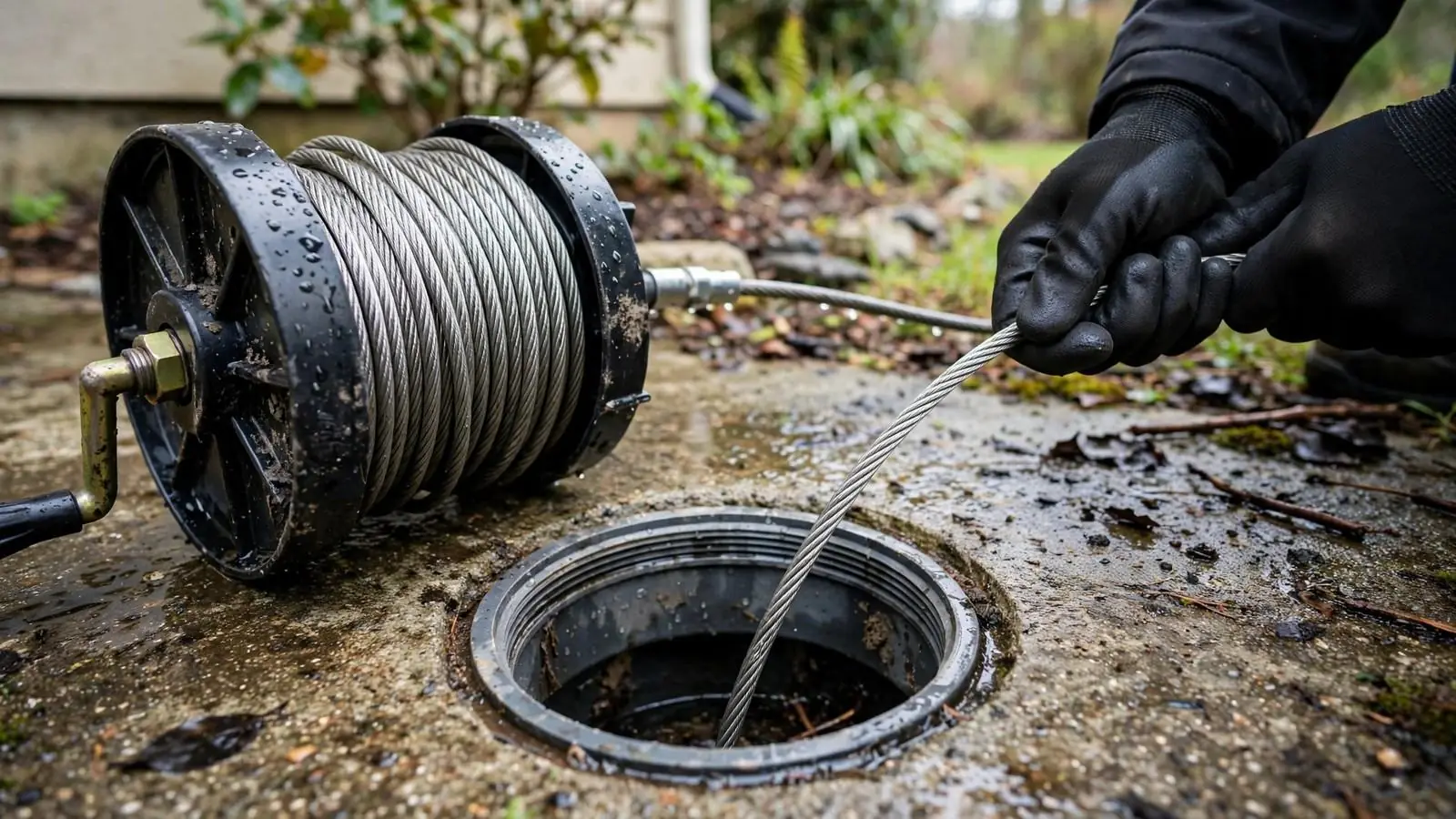
The usual tool is a drain cable with a cutting head, run in through a cleanout or the trap arm. For grease that has hardened along a long stretch, a hydro jet uses a high-pressure water nozzle to scour the pipe walls instead of poking a hole through the middle.
A small camera can confirm what the line looks like afterward. It shows whether grease was the whole story or whether a bellied pipe or root intrusion is holding water. Pricing depends on access, the length of the run and whether a camera is needed, and you should hear a clear price before work starts. If you want the full process, the drain cleaning page lays it out.
Backup risk and what to do if water rises
A slow sink can turn into a backup, especially if the main line is partly blocked. If water starts coming up in the basin or elsewhere, act quickly.
- Stop running water and the dishwasher right away.
- Do not use the disposal.
- If water is coming up in a tub or floor drain, a main line may be blocked. Avoid flushing and showering.
- Move rugs and cabinet contents away from the sink base.
- Tell the 24/7 dispatcher whether you are on city sewer or a septic tank, so the right plumber is sent.
Where we work
The same dispatch line covers Vine Grove and Elizabethtown, so a neighbor across town can use it too. Tell the dispatcher which sink, what you have already tried and whether the disposal runs.
Frequently asked questions
Usually a partial blockage. Grease and food film narrows the pipe a little at a time, so water still passes but slowly.
The trap, the disposal and the dishwasher connection are the first places to check.
Yes, but block the second drain with a wet rag or stopper first so the pressure goes down the line, not out the other side. Use a flat-bottom plunger and keep some water in the basin.
Do not plunge if you have used chemical cleaner, because it may splash.
It can help with a thin film, but it can also melt or loosen plastic trap fittings and crack some sinks. Very hot tap water is the safer choice.
Thick grease further down the line needs mechanical cleaning.
It can. The dishwasher shares the disposal inlet or tailpiece, and a clog there makes both sink and dishwasher slow.
If the sink is fine until the dishwasher runs, inspect the hose and air gap first.
Not always. If a cable clears the line and the drain stays fast for weeks, you may be done.
If it slows again, or other fixtures act up, a camera shows whether grease, a belly in the pipe or roots are behind it.
Hardin County Water District No. 1 runs the Radcliff sewer, and sewer bills follow water use. A slow drain by itself does not add water use, but a running toilet or a leak might.
If your bill jumps, check the meter for a leak, and ask HCWD1 how adjustments work.